Skip to content
Slate

Slate Recruiting

Your sourcing command center. Sign in to LinkedIn, describe the role, and let Slate build the shortlist.

Your session stays on your computer. No shared accounts. No outsourced recruiter identity.

slaterecruiter.com/recruiter/deciding
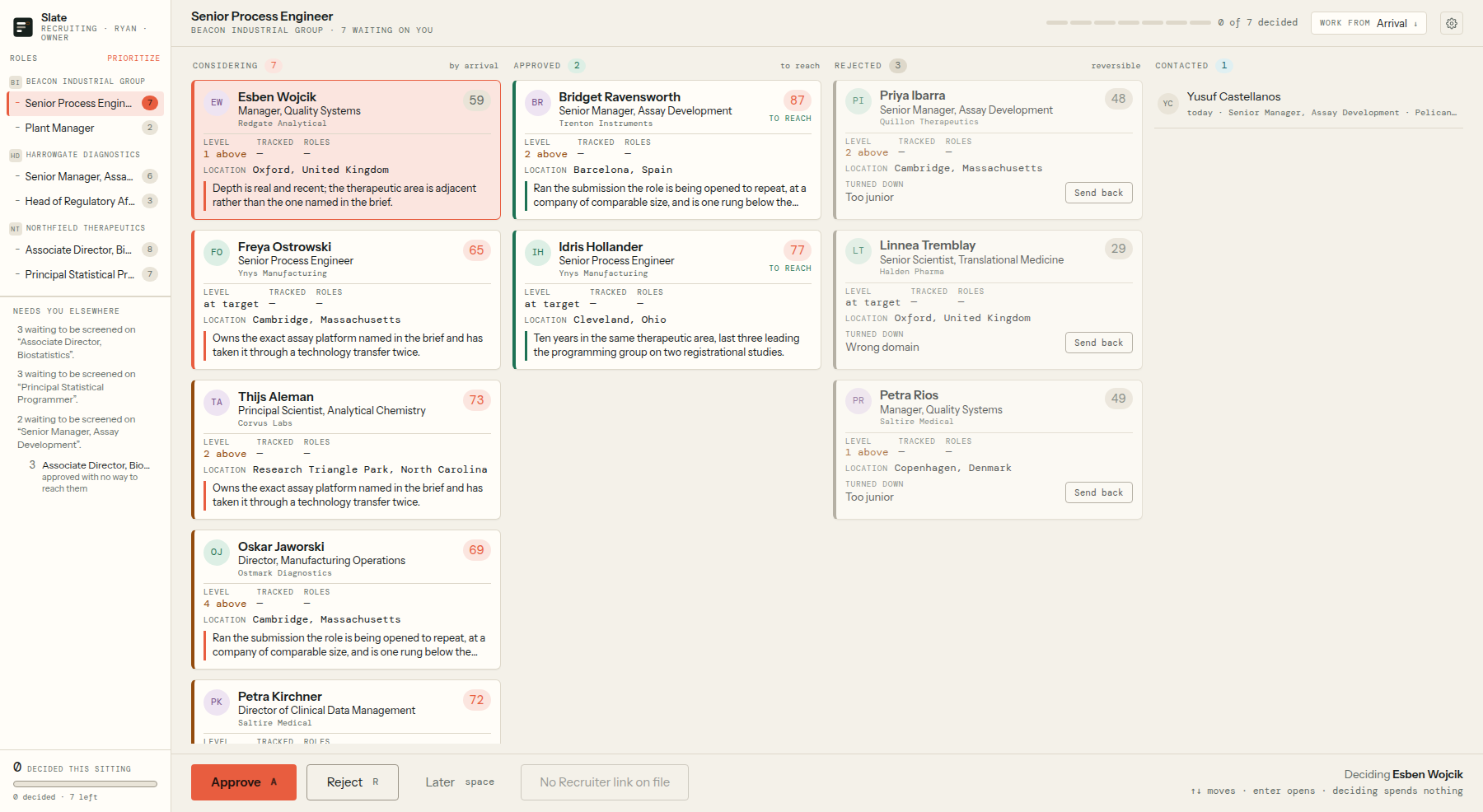
The deciding board: one candidate at a time with the screening verdict, the seniority rung against the role's target, and the reasons behind the score.
The deciding board, captured from the running product against scratch data. Not a mockup.

How it works

Three steps, and you can see all three.

Every screen below is the real product against scratch data. Slate does not have a demo mode that looks better than the thing you buy. Step zero happens off this page: you sign in to LinkedIn yourself, inside the Slate Collector on your own Mac.

Describe the role, and see what a search costs

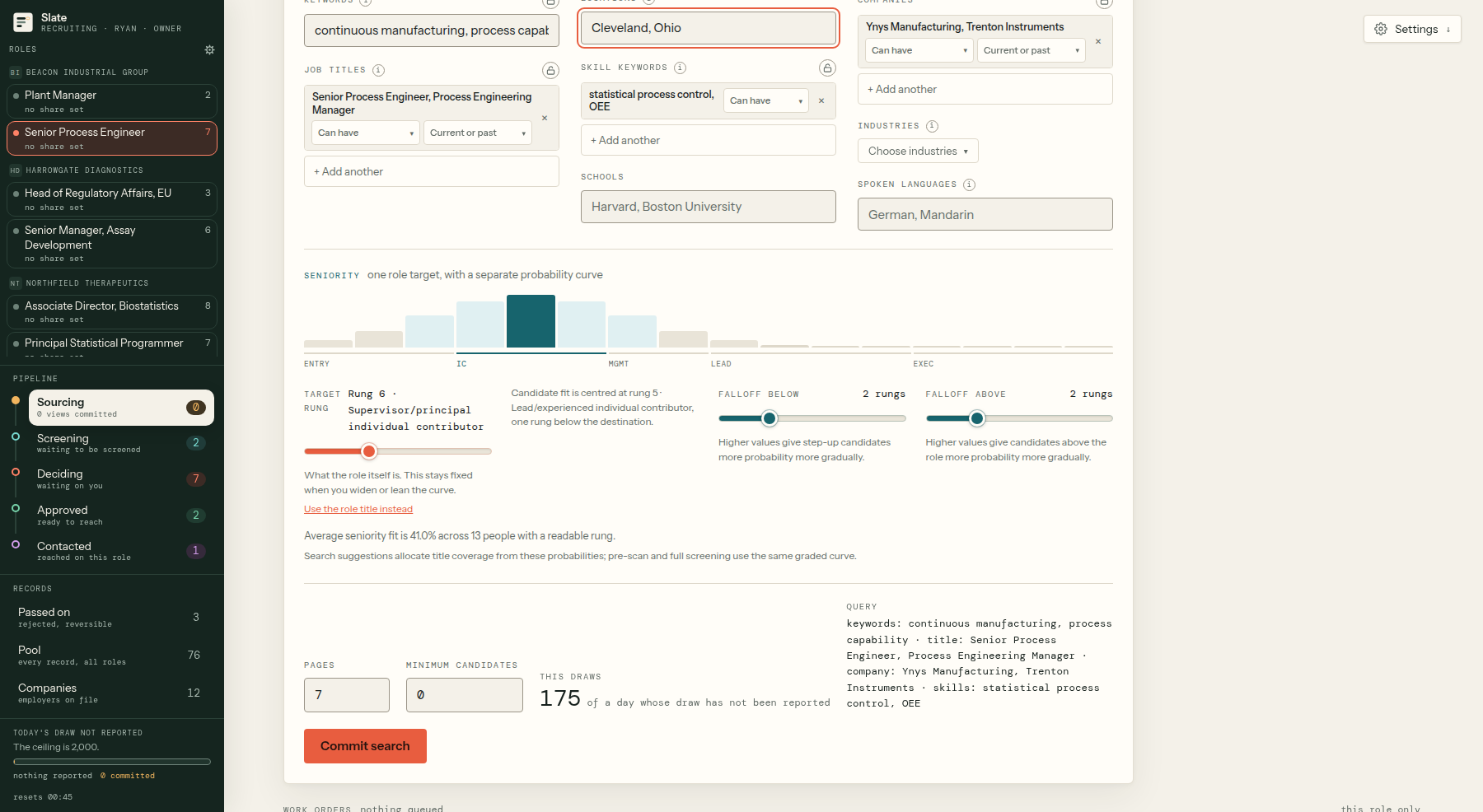
Paste the job description or a Recruiter search URL. Slate turns it into facets you can lock and a seniority target you can move on the sixteen-rung ladder. Before you commit, it says how many profile views the search will draw against today’s budget.
slaterecruiter.com/console
The sourcing screen: the role's search facets, the seniority target on the sixteen-rung ladder, the assembled query, and a line reading "this draws 175" above the commit button.
Cost first. The number above the button is what pressing it spends.

Screen against the brief, not against keywords

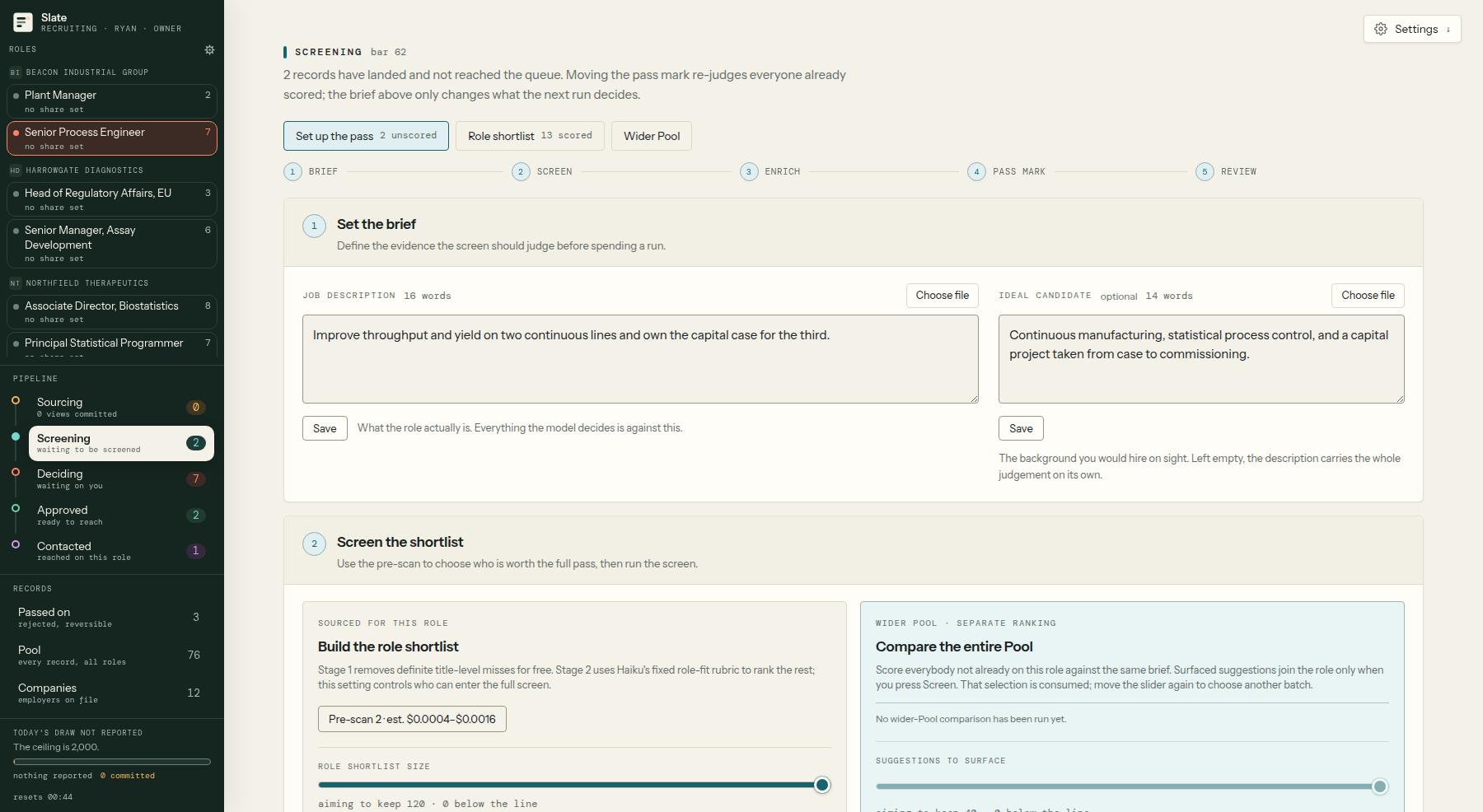
The brief is what the role actually is, and everything the model decides is against it. A cheap pre-scan removes definite title-level misses, then the full screen judges the rest. Both stages state their price before they run.

slaterecruiter.com/console
The screening setup: the job description and the ideal-candidate brief side by side, the pre-scan with its estimated cost, and the pass mark that admits people to the queue.
The pre-scan estimate is a real range from the model’s real prices.

Review the ranked shortlist with reasons

The reviewer gets one person at a time: the verdict, the rung the title parsed to, the evidence behind the score, and the reason it was flagged. Approve, reject with a reason, or skip to the next. Nothing is destroyed.

slaterecruiter.com/recruiter/deciding
The deciding board, with the people waiting on a decision in one column and the approved, rejected and contacted columns beside them.
Every card carries the sentence behind its score, and a decision is one keystroke.

What Slate is

Three things, each with the detail that makes it true.

Screening that reads the role, not keywords

A sixteen-rung seniority ladder parsed from verbatim titles, then function, ownership, scale, outcomes, hard requirements and recency. Every verdict carries its reasons, and every batch carries what it cost to run.

A verdict is three states, not two: pass, fail, and not yet judged. Collapsing the third into a fail is a real bug Slate has already had, and the product is now built so that one sentence never describes several states.

Sourcing that protects the account

Deliberate pacing against your seat's own daily budget. A canary that flags a quiet week as an anomaly rather than a thin market. A full stop on any checkpoint. The product says what a search will cost in views before you press it.

Rows in search results count against the limit, not just profile opens. Slate counts them the same way LinkedIn does, because for months it did not, and the budget governed a fraction of the real spend.

Two people, team volume

A pipeline that merges and never destroys. A deciding board for the reviewer and a console for the sourcer, as separate screens rather than one screen with a permission flag. Playbooks that make a general role and a life-sciences role both feel native.

A workspace holds up to four seats today, with per-role scoping so a recruiter sees only the roles they are assigned. The seat count is a setting on the workspace, not a number compiled into the product.

Account protection

The section a careful buyer reads first.

LinkedIn Recruiter Lite allows 2,000 unique candidate profiles per UTC day, and rows in search results count toward it. That budget belongs to your seat. Slate's job is to spend it deliberately and to show you the meter while it does.

Pacing
Collection runs at a human rhythm against the seat's own daily limit, not as fast as the network allows.
Cost first
Anything that spends views says how many before it runs. A “refresh everything” button is dangerous, so Slate does not have one.
Canary
A week that goes quiet is flagged as an anomaly to investigate rather than reported as a thin market.
Checkpoint stop
Any LinkedIn checkpoint halts collection and asks you. Slate never works around a login or a second factor.
Visits are visible
A profile visit is visible to the person visited. That is why visits run only after screening has cut the list, and why they can be switched off.

Profile views today

Example figures

1,180 / 2,000

  • 1,180 spent
  • 240 held for the run in progress
  • 580 unspent

These numbers are written into this page to show the shape of the meter. They are not a reading from anyone's account, and this site does not display real usage from the product. Inside Slate the same meter is drawn from the collector's daily ledger for your own seat.

slaterecruiter.com/products
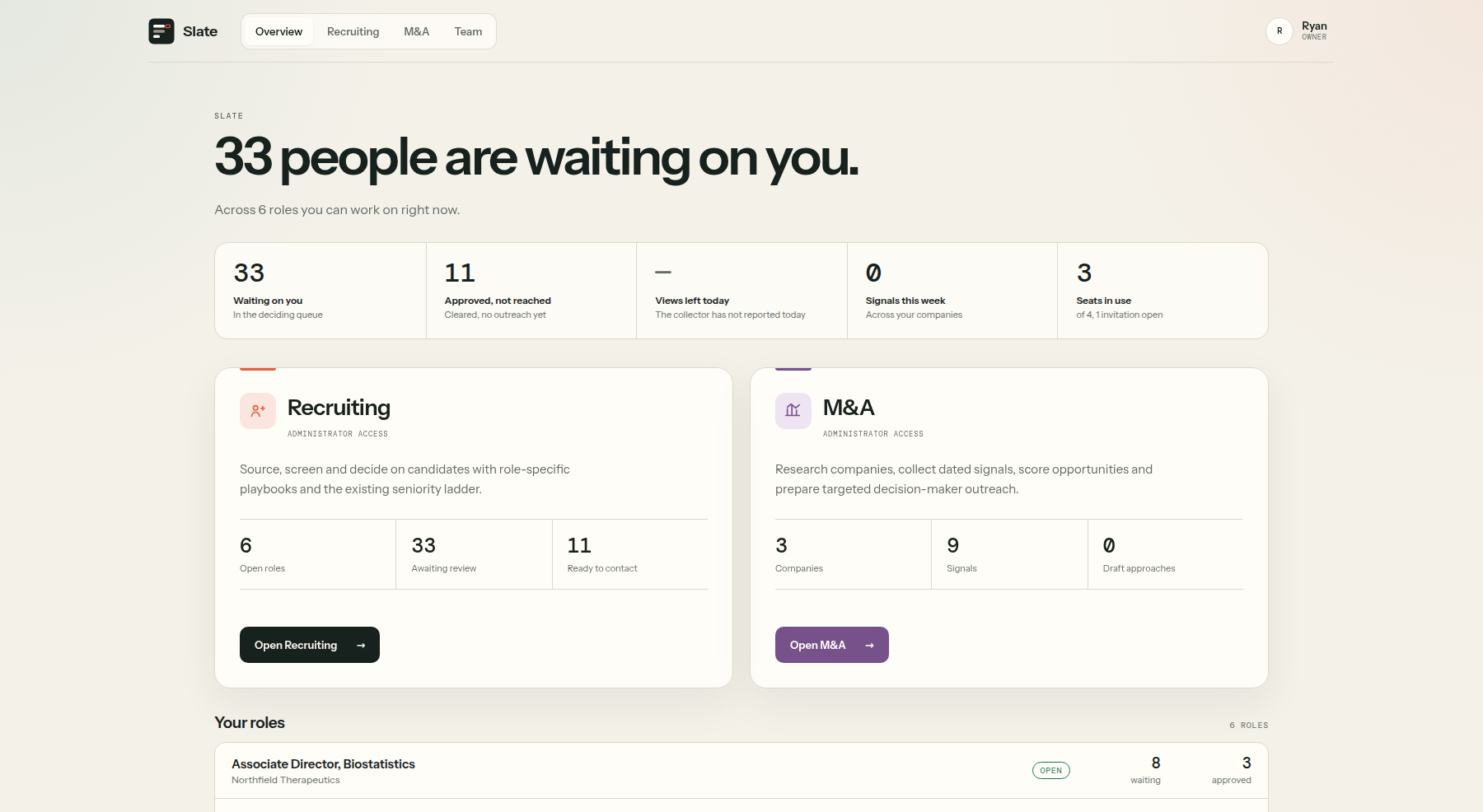
The workspace overview: the headline count of people waiting on a decision, a five-number strip that includes views left today reading "the collector has not reported today", and the two product cards with their real counts.
The same meter inside the product, on the workspace overview. When the collector has not reported, it says so rather than showing a zero.

Where each part runs

The architecture is the promise.

There is one connection between your machine and the Slate server, it carries orders one way and collected profiles the other, and your LinkedIn session is not on either end of it.

Where each part of Slate runs The recruiter's Mac runs the Slate Collector, which holds the LinkedIn session. The Slate server holds roles, candidate records, screening verdicts and the spend ledger. One webhook connects them: the server sends an order, the Collector sends back the profiles it collected. The LinkedIn session never crosses that line. YOUR MAC Slate Collector A desktop app you install and open. Your LinkedIn session You sign in yourself, in a browser on this machine. Slate never holds the password or the cookie. PACED AGAINST YOUR SEAT'S OWN DAILY LIMIT · STOPS ON ANY CHECKPOINT an order SEARCH · PACE · BUDGET one webhook PROFILES COLLECTED NOTHING ELSE CROSSES THE SLATE SERVER Your workspace One account, up to four seats. Roles, playbooks and searches Candidate records Screening verdicts and rationale Spend and the daily view ledger
LinkedIn credentials never leave your computer. Slate holds the roles, the candidate records, the screening verdicts and the spend ledger; the Collector holds the session and does the collecting.

Playbooks

A title means different things in different markets.

A playbook is the vocabulary Slate screens against: which titles count as which rung, which requirements are hard, and which words are noise in this field.

General

The default. Reads ownership, scope and scale from the title and the history, without a market's private vocabulary. Use it for software, finance, operations and anything not yet given its own playbook.

Life sciences

The proven one. Knows that Principal Scientist and Associate Director are not interchangeable, that a CRO title and a sponsor title carry different weight, and which therapeutic-area words are evidence rather than decoration.

What a playbook changes

  • Which rung a verbatim title parses to, and the target rung for the role.
  • Which requirements are hard filters and which are preferences.
  • The search facets Slate proposes, and which of them you lock.
  • The wording of the rationale on every verdict.

Slate M&A Early access

Know which companies are about to transact, with the evidence attached.

  • Signals with sources. Filings, press and hiring, each stored with the URL it came from and the date it appeared.
  • Scores that rank evidence. Three separate scores that order a universe by how much evidence there is. They are not probabilities and are not presented as predictions.
  • A named buying group. The decision-makers on a deal, each with the provenance of how Slate learned about them.

Hit rate is measured on your own flags once there is history to measure. There is no number on this page because there is no number yet.

Ask about early access

slaterecruiter.com/m-and-a
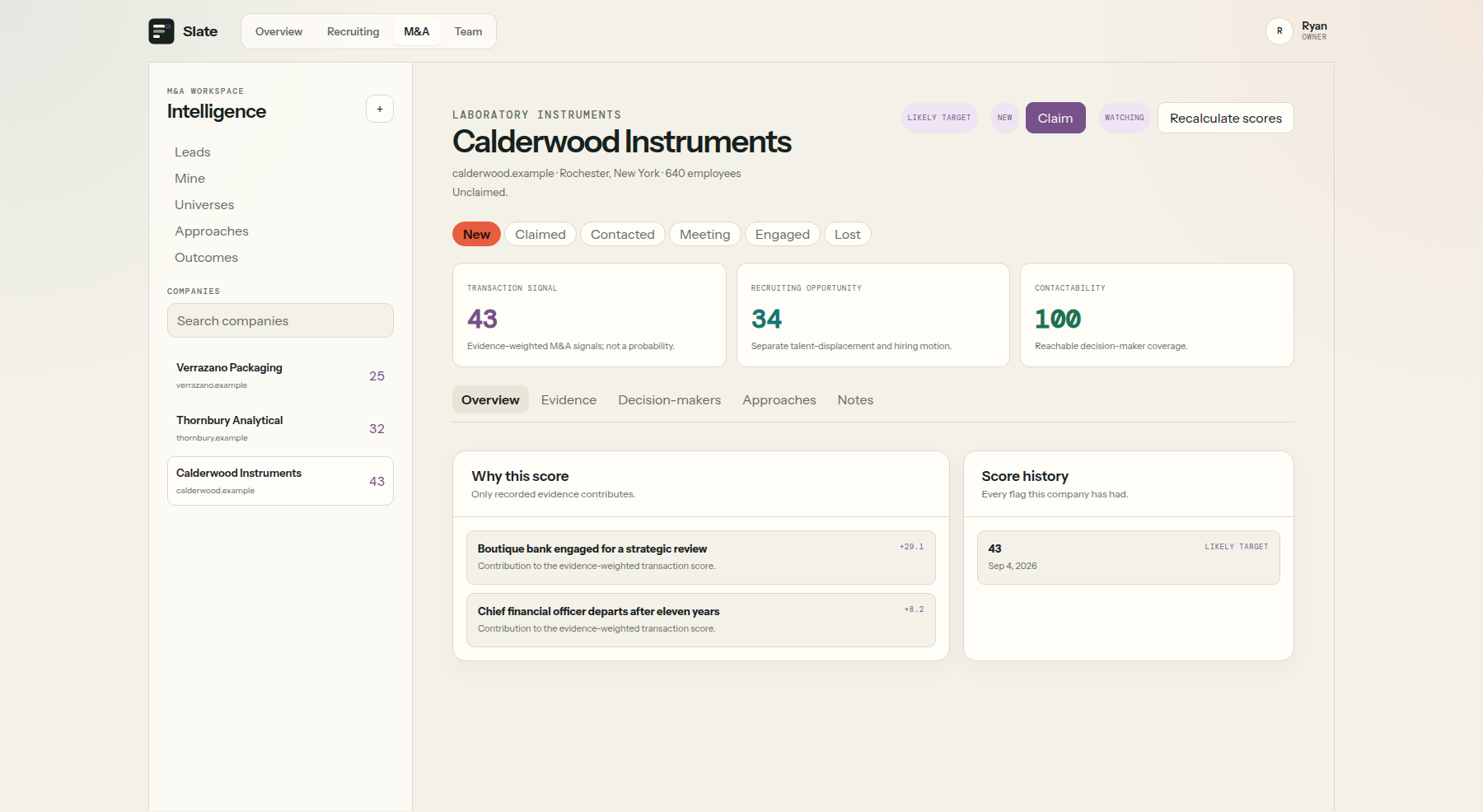
A company record in Slate M&A with its dated signals and the source link on each one.
A company record with its evidence, captured against scratch data.
slaterecruiter.com/m-and-a
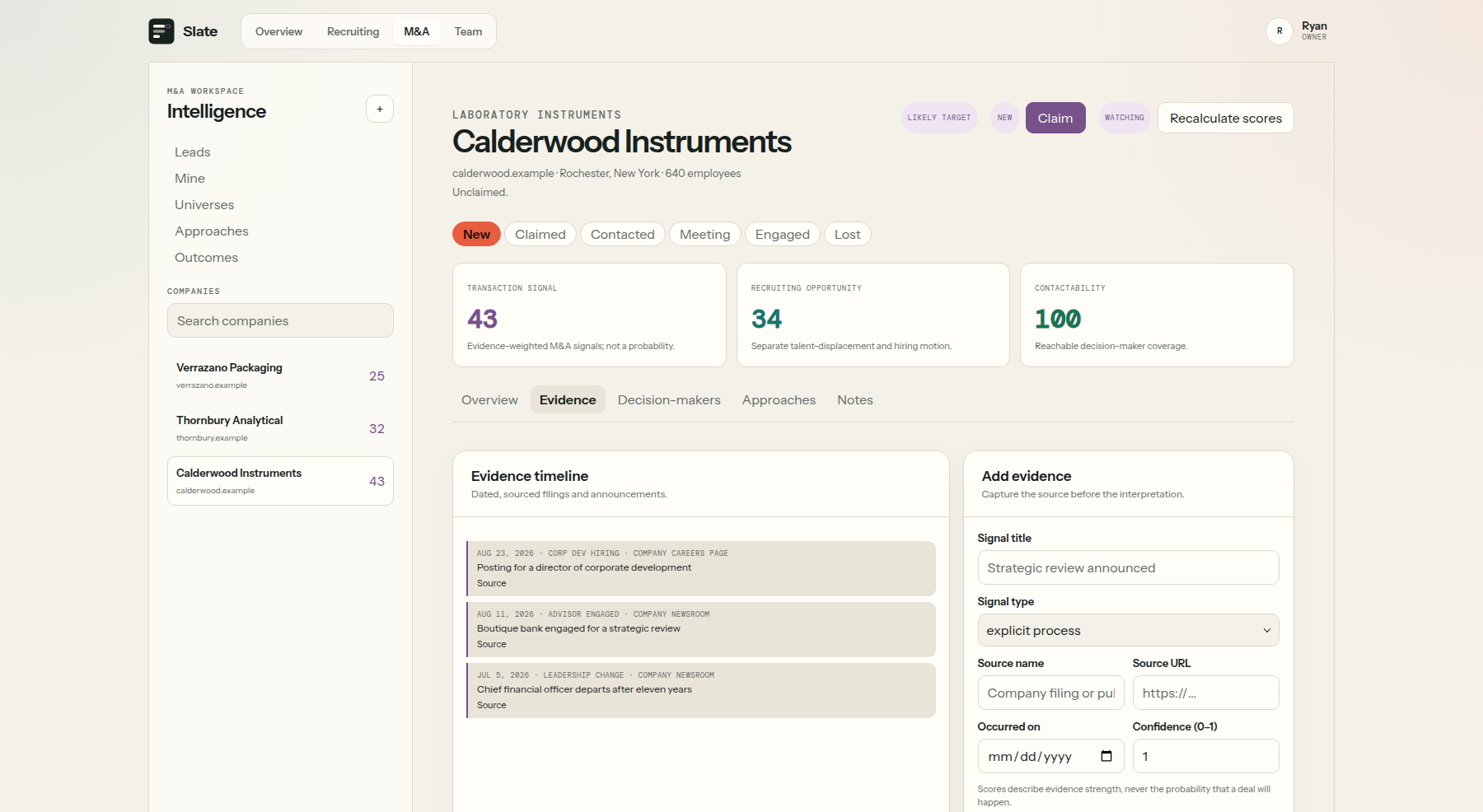
The evidence timeline for one company: each entry with its date, the kind of signal it was classified as, the source that reported it, and a link to open that source.
Every signal keeps its date, its source and a link to it. The fact and the URL are never model-generated.

Pricing

Priced against what it costs to run.

Screening is a model call per candidate and is metered per candidate. Enrichment is billed per contact by a named provider and is metered with a ceiling you set. Profile views belong to your own seat, so Slate does not sell them.

Slate Recruiting

From $149 per month

One seat on Solo, up to four on Team, both products of the same workspace. Metered screening with the per-candidate rate stated up front.

Slate M&A Early access

From $299 per month

Priced on universe size, because universe size is what the ingestion costs. Two free sources today and no licensed news feed yet, and the price says so.

See the full pricing, with the driver behind every number